SMS vs Email Marketing for Shopify: Which Channel Wins in 2026?
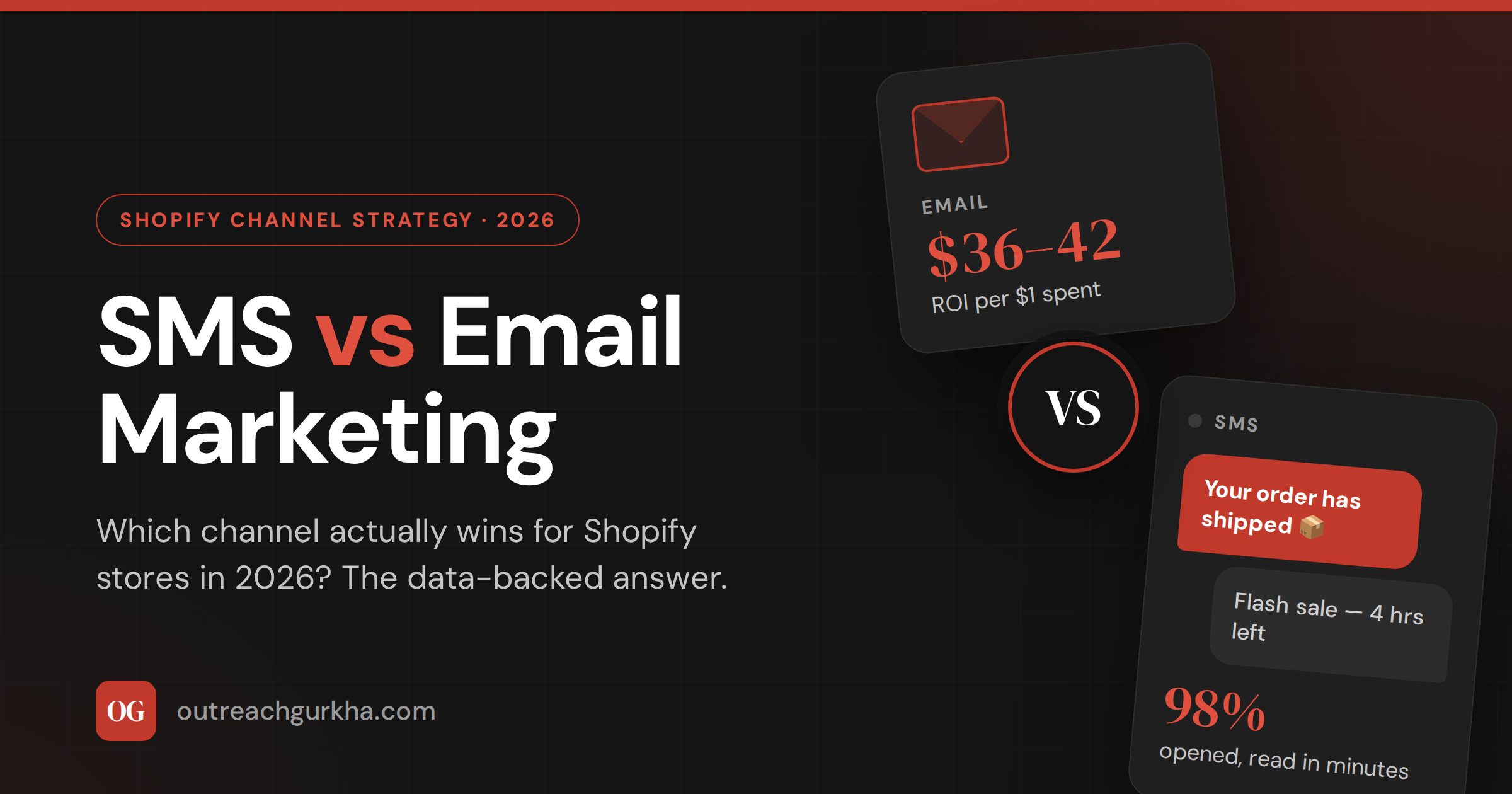
SMS gets opened 98% of the time. Email returns $36–$42 for every $1. The “which wins” framing is the wrong question — the right one is which is your foundation and which is your accelerant. This is the data-backed answer for Shopify owners deciding where to put their money.
Ask ten marketers whether SMS or email wins and you’ll get ten confident, contradictory answers. SMS people point to the 98% open rate. Email people point to the ROI that beats every other channel. Both are right — which is exactly why the versus framing leads stores to the wrong decision.
These are not competitors. They are different tools for different jobs, and the highest-revenue Shopify stores run both in a deliberate sequence rather than picking one. This guide gives you the benchmark data side by side, the specific moments each channel wins, how to combine them, and the channel stack we’d actually build for a Shopify brand in 2026.
1. The Quick Answer: You Need Both — But Email Is the Foundation
If you only have the budget or bandwidth to build one channel properly, build email first. Here’s the reasoning, before the data backs it up.
Email is an owned asset with near-zero marginal cost. Once someone is on your list, emailing them costs a fraction of a cent. You can send 8–12 times a month without fatiguing the list, which means email can carry your entire relationship: education, storytelling, complex offers, lifecycle automation, and the slow nurture that builds lifetime value. And it still returns more per dollar than any other channel — $36–$42 for every $1 spent across 2025–2026 benchmarks.
SMS is the accelerant, not the engine. Its superpower is immediacy — a 98% open rate, most messages read within minutes. But that intimacy comes with constraints: it costs $0.01–$0.05 per message, tolerates only 4–6 sends a month before opt-outs climb, and gives you ~160 characters with no room for a story. SMS is devastating for the right moment and wasteful for everything else.
2. Head-to-Head: SMS vs Email vs Social vs Direct Mail
Here is how the four major direct channels compare on the metrics that actually decide where your money goes. Figures are 2025–2026 ecommerce benchmarks; treat them as ranges, not promises — your numbers depend on list quality, segmentation, and offer.
| Channel | Open / seen rate | Click / response | Cost per contact | Typical ROI |
|---|---|---|---|---|
| 20–35% | 2–3% CTR | ~$0.001 (near-zero) | $36–$42 per $1 | |
| SMS | ~98% | 10–20% CTR | $0.01–$0.05 | $8–$12 per $1 |
| Social media | 2–5% organic reach | ~1% CTR | $0.94–$3.78 per click (paid) | Variable · rented audience |
| Direct mail | ~90% seen | 4–9% response (house list) | $0.40–$3.00+ per piece | Strong only at high AOV |
Sources: EasyApps Ecommerce 2026 (SMS vs email ROI), Subtext 2026 SMS Benchmarks (10B+ messages), ANA/DMA 2025 Response Rate Report (direct mail), Meta advertising benchmarks 2025.
What the table actually tells you, read honestly:
SMS wins on attention and immediacy — nothing else gets a 98% open rate or double-digit click rates. Email wins on economics and scale — near-zero send cost, the highest ROI of any channel, and the frequency headroom to nurture. Social media is a discovery and brand channel, not a direct-response engine; organic reach keeps shrinking and paid traffic is rented, not owned. Direct mail commands genuine attention and posts strong response rates, but the per-piece cost only pencils out for high-AOV or high-LTV brands — for a typical $40-AOV Shopify store, the math rarely beats email.
The number that reframes the whole debate: SMS costs roughly 10–50× more per message than email and returns roughly a quarter of the ROI per dollar. That doesn’t make SMS bad — it makes SMS a precision instrument. You don’t pay a premium to send a weekly newsletter by text. You pay it for the moments where a 98% open rate within minutes is worth the cost.
3. When to Use SMS: Urgency Is the Whole Point
SMS earns its premium in moments where speed and certainty of delivery directly drive revenue. If a message doesn’t need to be read in the next ten minutes, it probably shouldn’t be a text.
✓
✓
✓
✓
✓
4. When to Use Email: Everything That Needs Room to Breathe
Email is where the relationship lives. Anything that requires explanation, storytelling, multiple products, or a slow build belongs here — and so does the bulk of your lifetime-value work.
→
→
→
→
→
5. How to Combine SMS + Email for Maximum Shopify Revenue
The blended program beats either channel alone — not by sending the same message twice, but by assigning each touch to the channel that fits its job. Email carries the context; SMS lands the urgent nudge. Here’s what that orchestration looks like in the flows that matter most.
Email does the heavy lifting
- Welcome series and brand introduction
- Full abandoned-cart sequence (first touch)
- Post-purchase education and cross-sell
- BFCM teasers and multi-day warm-up
- Newsletters, stories, win-back narratives
SMS lands the urgent nudge
- Cart reminder ~1 hour after the email
- Shipping and delivery confirmations
- Back-in-stock and price-drop alerts
- Flash-sale “ending tonight” reminders
- BFCM day-of launch + VIP early access
A worked example — abandoned cart, blended: Email #1 goes out 1 hour after abandonment with the product, reviews, and a reason to return. If no purchase, an SMS follows at hour 4: “Still thinking it over? Your cart’s saved — here’s free shipping for the next 2 hours.” Email #2 lands at hour 24 with social proof. The email gives context the text can’t; the text gives urgency the email can’t. Blended cart recovery routinely outperforms either channel run alone — which is the whole case for using both.
The rule that keeps the blend healthy: never duplicate. If a subscriber got the message by email, don’t repeat it by SMS an hour later — that’s how you train people to opt out of both. Use SMS only where it adds urgency the email couldn’t, and only to subscribers who opted in to texts specifically.
6. CRM vs. Email Marketing Platform: What Does a Shopify Store Actually Need?
This is where store owners burn money on tools they don’t need. The terms get used interchangeably, but they solve different problems.
An email marketing platform (ESP) — Klaviyo, Omnisend, Mailchimp — exists to send email and SMS, automate flows, segment your list, and report on revenue per channel. A CRM (customer relationship management system) — Salesforce, HubSpot — exists to track relationships, deals, and pipeline, usually for sales teams managing high-touch or B2B customers over long cycles.
| Question | Email platform (ESP) | CRM |
|---|---|---|
| Core job | Send, automate, segment, report on campaigns | Track relationships, deals, and sales pipeline |
| Built for | Ecommerce and DTC sending at scale | Sales teams, B2B, long consideration cycles |
| Handles SMS + email | Yes — both in one place | Usually via add-ons or integrations |
| What a Shopify store needs | This — almost always | Rarely, until high-touch or wholesale |
For the overwhelming majority of Shopify stores, the answer is simple: a modern ESP with built-in CRM features is all you need. Platforms like Klaviyo already store customer profiles, purchase history, and behavioral data, and run both email and SMS from one system — that’s effectively the CRM layer a DTC store requires. A separate, dedicated CRM only earns its place when you’re running wholesale, high-AOV consultative sales, or a sales team working individual relationships. Buying Salesforce to run a $50K/month Shopify store is paying for machinery you’ll never turn on.
7. The Channel Stack We Recommend for Shopify Brands
Here is the stack we’d actually build, in the order we’d build it, for a Shopify store doing $10K–$150K/month.
The principle underneath the stack: own your audience before you rent attention. Email and SMS are channels you control; social and paid are channels you rent. Build the owned engine first, layer urgency on top, and use rented channels to feed it — not to carry it.
SMS vs Email Quick Reference — 2026
Not sure where to start?
Book a Free Strategy Call with Outreach Gurkha
We’ll look at your store, your list, and your current channels, and tell you exactly where the revenue is hiding — email first, SMS where it counts. No pitch deck, no obligation. Just the plan we’d run.
No retainer. No setup fee. We charge 10% of the revenue we generate — after it lands in your Shopify account.
30-minute call — we map your channel stack live.
Free email + SMS audit, delivered as a Loom.
For Shopify stores doing $10K–$150K/month.