Is Email Marketing Dead? The Truth for Shopify and Ecommerce Brands in 2026
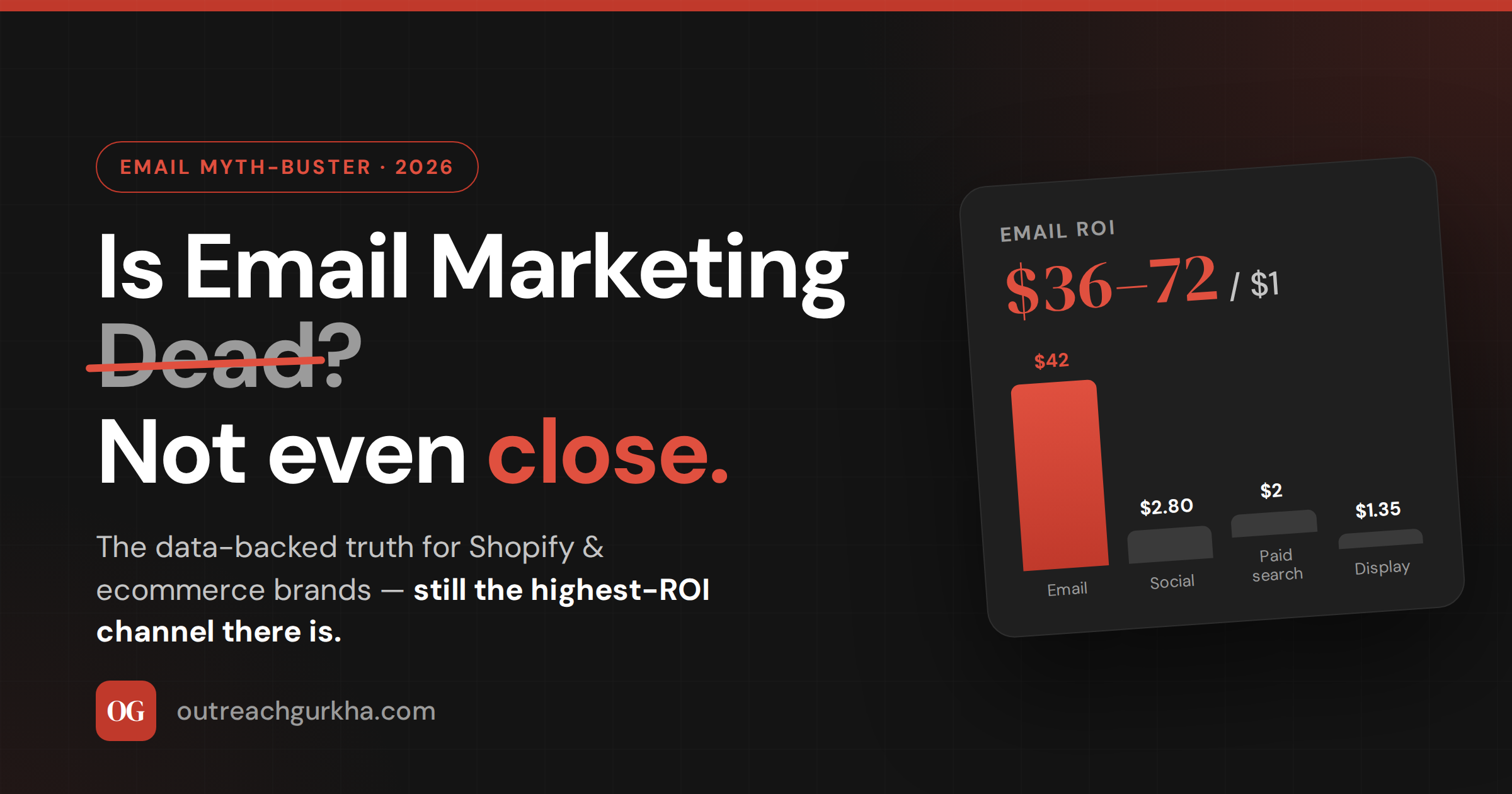
Every year someone declares email dead. Every year it returns more revenue per dollar than any other channel — $36–$42 for every $1, and up to $72 for US ecommerce. Email isn’t dying. Bad email is. Here’s the data, the objections, and the truth.
Let’s settle this in one line before we go any further: email marketing is not dead, and the data doesn’t even make it close. It generates a 3,600%+ return, drives up to 40% of ecommerce revenue, and posted its fifth straight year of rising open rates in 2025. No channel that’s “dying” does that.
So why does the “email is dead” line keep circulating? Because for a lot of brands, their email genuinely doesn’t work — and it’s far easier to blame the channel than the execution. This article separates the two. We’ll show you the 2026 numbers, name what’s actually changed, and explain the real reason email underperforms for most stores. Spoiler: it’s not the channel.
1. Why People Keep Saying Email Is Dead (And Why They’re Wrong)
The “email is dead” claim resurfaces every couple of years, and it always rests on the same three arguments. Each one sounds reasonable and each one falls apart on contact with the data.
“Inboxes are too crowded.” True that the average person gets 121 emails a day — but crowding is an argument for better email, not no email. The brands cutting through aren’t the ones who stopped sending; they’re the ones who got more relevant. “Younger buyers don’t use email.” Also wrong: 99% of email users check their inbox daily, and email remains the channel most people check before social or news. “Social media replaced it.” This one’s backwards — social is rented reach with ~1% engagement and shrinking organic visibility, while email is an owned audience you can reach at near-zero cost. You don’t replace the channel you own with the one you rent.
2. The Data: Email Marketing Stats in 2026
Here is what the channel actually looks like this year, across the metrics that matter for an ecommerce brand.
Sources: Omnisend 2026 report, Emailmonday 2026, Litmus 2026, Statista.
Put against the alternatives, the gap isn’t subtle — it’s an order of magnitude.
| Channel | Return per $1 spent | What it tells you |
|---|---|---|
| $36–$42 (up to $72 US ecommerce) | Highest-returning digital channel, and the gap is widening | |
| Paid search | ~$2 | Effective, but you stop showing up the moment you stop paying |
| Social advertising | ~$2.80 | Rented reach on a platform that owns the relationship |
| Display ads | ~$1.35 | Low intent, easily ignored, declining returns |
And the engine underneath those numbers is automation. Automated flows make up only about 2% of email volume but generated roughly 37% of all email-attributed sales — because automated emails earn around $1.94 per recipient versus $0.11 for one-off campaigns. That’s not a rounding difference. That’s the difference between a channel that works and one that’s left switched off.
3. What HAS Changed About Email
Here’s the honest part. Email isn’t dead — but it isn’t 2015 either. Three real shifts have changed how the channel works, and pretending they haven’t is its own kind of denial.
4. Why Email Still Outperforms Every Other Channel for Shopify Revenue
Strip away the noise and email wins on four structural advantages that no other channel can match at once.
It’s an owned audience — you control the relationship, not an algorithm that can throttle your reach overnight. It has near-zero marginal cost — once someone’s on your list, reaching them costs a fraction of a cent, which is why the ROI math is so lopsided. It’s directly attributable — on Shopify with a platform like Klaviyo, you can trace revenue to the exact email that drove it, something paid social can only approximate. And it’s built for lifecycle — welcome, cart recovery, post-purchase, win-back; the automated sequences that quietly compound lifetime value while you sleep.
The conversion numbers settle it: One in three people who click an automated email go on to buy — versus one in eighteen for a scheduled campaign. Roughly half of people who click a welcome or abandoned-cart email end up purchasing. No paid channel converts warm, owned, intent-rich traffic at those rates. That’s not a channel on life support. That’s the highest-leverage asset most Shopify stores own and underuse.
5. Real Results: What “Crushing It” Actually Looks Like
The numbers above are industry-wide. Here’s what they look like at the store level — the patterns we see again and again in brands running email properly in 2026.
Cart-abandonment automations average $3.65 revenue per recipient, with top performers hitting $28.89. A single well-built flow routinely recovers 3–5% of otherwise-lost sales — money that was already walking out the door.
Brands that build the full flow stack see automations earn ~30× more revenue per email than one-off promos — turning email from an occasional sale-blast into an always-on revenue system that runs in the background.
Stores running email strategically routinely see it drive 30–40% of total revenue — the single largest controllable line in the P&L, and one that doesn’t reset to zero the day they pause ad spend.
The common thread isn’t a clever subject line or a lucky campaign. It’s a system: the right flows, the right segmentation, and a planned calendar. The brands “crushing it” with email aren’t doing something magic — they’re doing the basics, consistently, while their competitors send a newsletter when they remember.
6. The Real Reason Email “Doesn’t Work” for Most Brands
Here’s the uncomfortable truth behind every “email doesn’t work for us.” In almost every case, the channel isn’t the problem — the execution is. When we audit a store that’s convinced email is dead, we find the same things.
✗
✗
✗
✗
None of these is a channel problem. Every one is a fixable execution problem. Email “not working” is almost always email not being done — and that’s good news, because execution is something you can change starting this week.
7. What Great Email Marketing Looks Like in 2026
So what does a healthy, modern email program actually involve? It’s not complicated — it’s just done deliberately.
It runs the five core automated flows — welcome, abandoned cart, post-purchase, browse abandonment, win-back — continuously in the background, because that’s where the revenue-per-recipient lives. It segments instead of blasting, sending the right message to the right slice of the list rather than everything to everyone. It measures revenue, not opens — placed-order rate and revenue per recipient, not vanity metrics that iOS made meaningless. It protects deliverability with authentication and list hygiene so the emails actually arrive. And it follows a planned calendar with a healthy mix of selling and relationship content, rather than a panicked blast whenever revenue dips.
Is Email Dead? — Quick Reference 2026
Find out what your email is really worth
See If Your Email Program Is Leaving Money on the Table
If email “isn’t working” for your store, the channel almost certainly isn’t the problem — the setup is. We’ll audit your flows, segmentation, deliverability, and calendar, and show you exactly where the revenue is hiding.
No retainer. No setup fee. We charge 10% of the email revenue we generate — after it lands in your Shopify account.
Free audit delivered as a Loom in 48 hours.
We show you the revenue gap, not vanity metrics.
For Shopify stores doing $10K–$150K/month.