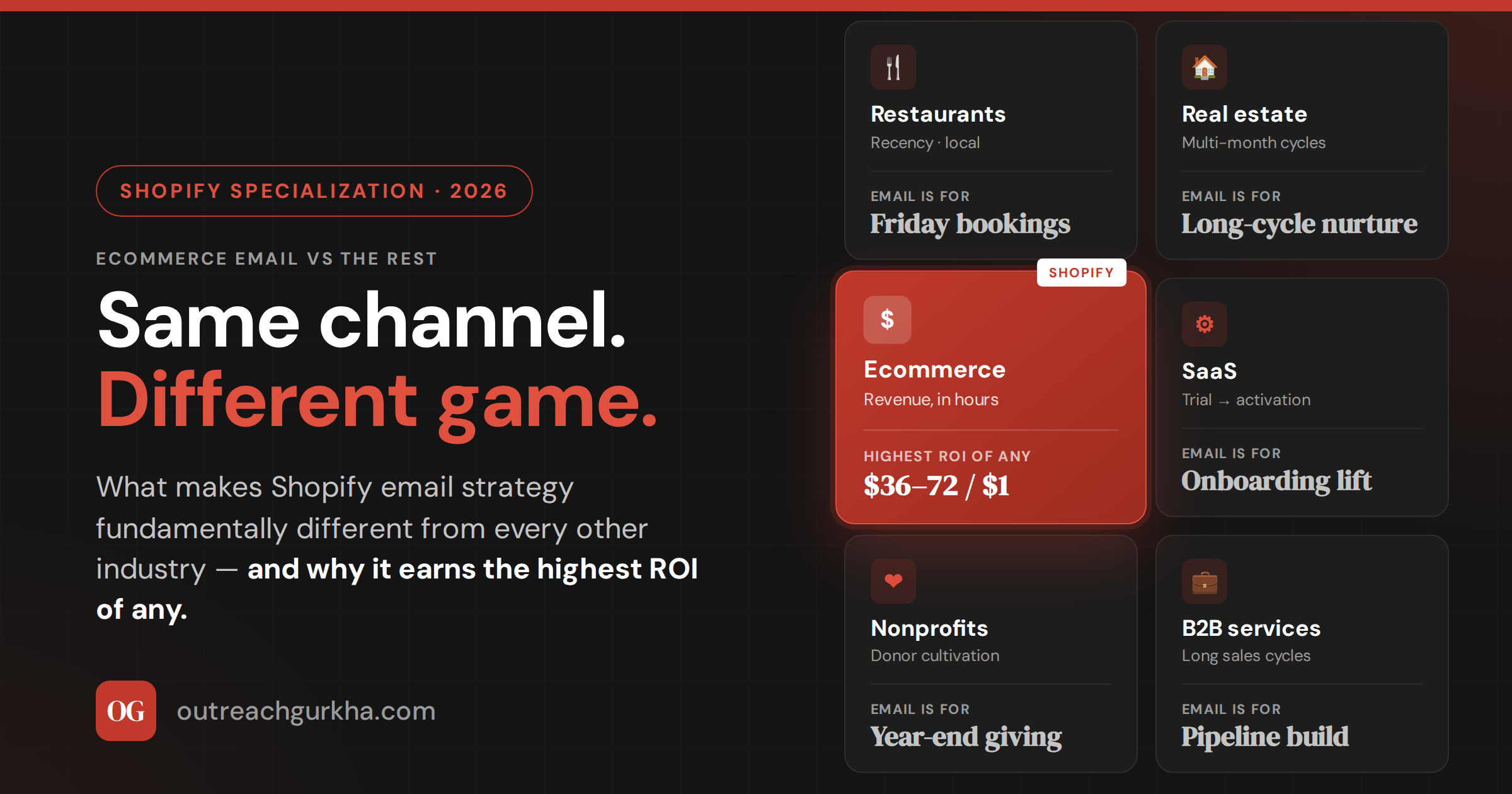
Email Marketing for Ecommerce vs. Other Industries: What Makes Shopify Email Strategy Unique
A SaaS marketer, a restaurant operator, and a real estate agent all use email — but the strategy underneath looks nothing alike. Here’s what makes Shopify email its own discipline, what it can borrow from the others, and why a general email agency rarely understands the difference.
The mistake most stores make when hiring an email agency: they assume email is email. A skilled marketer should be able to write a great campaign whether the client sells handmade ceramics, manages apartment listings, or runs a SaaS trial funnel. The mechanics are universal — subject lines, copy, design, segmentation. Right?
Not really. Below the surface of “send better emails,” the strategy each industry runs is radically different. The cadence is different. The data is different. The metrics that matter are different. The automation triggers don’t exist in the same form. And the part that decides whether email actually generates revenue — knowing which lever moves which number — is industry-specific in a way most agencies don’t admit.
This is the case for ecommerce email as its own discipline, what it can borrow from other industries, and what the Shopify-specific toolkit actually looks like.
1. How Ecommerce Email Differs From Other Industries
The fundamentals look similar at thirty thousand feet. At ground level, the strategy each industry runs is built around a completely different transaction model.
| Industry | Transaction model | What email is for |
|---|---|---|
| Ecommerce (Shopify) | Frequent low-to-mid AOV purchases, short cycles, behavioral triggers | Direct revenue attribution per send — and the LTV engine |
| Restaurants & hospitality | Recency- and occasion-driven, hyper-local | Brand presence, weekly bookings, Friday-night psychology |
| Real estate | Multi-month consideration, high-AOV, hyper-segmented | Long-cycle nurture — keeping you top-of-mind for years |
| SaaS | Trial → activation → expansion, MRR mindset | Product education, onboarding, retention, upgrade prompts |
| Nonprofits | Donor cultivation, mission-driven, year-end peaks | Emotional resonance and recurring giving asks |
The clearest divergence is what email actually does for the business. A SaaS company sends email to walk a trial user from sign-up to activation; revenue per email is a meaningless metric because the trial doesn’t convert for two weeks. A nonprofit sends email to build emotional connection that pays off in a $500 donation eight months later. A restaurant sends email to fill Saturday’s reservations.
Ecommerce email is the one where the gap between “email sent” and “revenue received” is hours, not months. That single fact reshapes every strategic choice — the cadence, the metrics, the automation, the role of urgency, the importance of behavioral triggers. A great real estate email program would be a disaster for a Shopify store. The reverse is also true.
2. What Shopify Stores Can Learn From Other Industries
None of this means Shopify owners should ignore what other industries do well. The brands with the most distinctive email programs in ecommerce are the ones borrowing the best moves from elsewhere.
Restaurant emails read like a person. A chef’s note, a “what we cooked this week” recap, a Friday note about the playlist they’re spinning. Ecommerce emails are often the opposite — corporate, generic, branded into oblivion. The Shopify brands that pull voice from hospitality consistently outperform the ones that don’t.
SaaS treats onboarding as a multi-week strategic priority. Most ecommerce brands treat it as a single welcome email with a 10% discount. The Shopify stores that build proper post-purchase education flows — three to five touches over the first month, teaching the customer to use what they bought — see lifetime value lift dramatically. SaaS figured this out first.
A real estate agent who emails buyers and sellers the same message has no business. A Shopify store that emails first-time customers and 6-purchase loyalists the same message is doing exactly that — and most do. The segmentation discipline from real estate (intent, stage, history) maps directly onto ecommerce, and the stores that adopt it lift revenue per recipient meaningfully.
Nonprofits sell something invisible — impact — and they do it through emotion, story, and a clear “why.” Ecommerce brands that emulate this in their founder notes and storytelling emails convert subscribers into customers far more reliably than ones that lead with product specs.
3. Why Ecommerce Email Has the Highest ROI Potential of Any Industry
Across studies and benchmarks, one industry consistently outperforms every other on email ROI — and the reasons are structural, not accidental.
Four structural reasons explain why ecommerce sits at the top. First, direct attribution — Shopify + Klaviyo connect every email to every purchase in a clean data trail no other industry has natively. Second, short consideration cycles — a cart abandonment email can convert within an hour; a SaaS nurture takes weeks. Third, repeat purchase opportunity — every customer is a candidate for a second, third, tenth order, which compounds LTV in a way one-shot industries can’t match. And fourth, behavioral triggers — viewed product, abandoned cart, browse, post-purchase windows give ecommerce a richer automation surface than almost any other industry.
Together, those four advantages mean an ecommerce email program built properly will generate more revenue per dollar spent than a SaaS, B2B, real estate, or nonprofit program of equivalent investment. The ceiling is just higher.
4. The Unique Shopify Email Toolkit
The reason ecommerce ROI is structural — not just “marketers got better” — comes down to three specific capabilities that the Shopify + Klaviyo (or equivalent ESP) stack makes possible, and that most non-ecommerce email programs simply don’t have.
5. Common Mistakes Marketers from Other Industries Make in Ecommerce
When a marketer experienced in another industry takes on a Shopify email program — or when a general agency applies a playbook that worked elsewhere — the same patterns of mismatch show up.
✗
✗
✗
✗
✗
6. Why Working With a Shopify-Specific Agency Matters
None of the above means a generalist can’t run a Shopify email program. It means they’ll spend the first six months learning what a specialist already knows — and your revenue pays the tuition.
A Shopify-specific agency walks in already knowing things that take a generalist a year of trial and error to develop. The Klaviyo flow templates that actually convert for skincare versus apparel versus food. Which Shopify events fire when, and which ones to build automation around. How the BFCM calendar compounds across November. The cart attribution window settings that under- or over-credit email. The deliverability nuances between Shopify Plus and basic plans. The fact that a 3-email cart sequence usually outperforms a 5-email one for most categories.
The specialist’s actual edge isn’t talent — it’s pattern recognition. We’ve seen what’s broken in fifty Shopify email programs, so we know what’s likely broken in yours within an hour of looking. A generalist email agency does great work in their lane, but Shopify isn’t their lane. They’ll diagnose your store using frameworks built for industries that don’t share ecommerce’s behavioral data, attribution speed, or repeat-purchase economics — and the diagnosis won’t quite fit.
Niche expertise compounds. The best general email agency on the planet won’t beat a competent specialist on Shopify-specific revenue, for the same reason the best general practitioner won’t beat a cardiologist on heart surgery. Email is a craft; ecommerce email is a sub-craft. Match the craftsman to the work.
Shopify Email Specialization — Quick Reference 2026
If you’re working with a general email agency
See What a Shopify Specialist Can Do Differently
We only work with Shopify stores. Every flow we build, every campaign we ship, every dashboard we deliver is calibrated against patterns we’ve seen across dozens of ecommerce programs — not borrowed from industries where the rules are different.
No retainer. No setup fee. We charge 10% of the email revenue we generate — after it lands in your Shopify account.
Shopify-specific audit delivered as a Loom in 48 hours.
Flows benchmarked against ecommerce, not generic email.
For Shopify stores doing $10K–$150K/month.