B2B Email Marketing Strategy for Shopify Wholesale and DTC Brands
B2B email isn’t DTC email at higher AOV — it’s a different discipline entirely. Longer cycles, multiple decision-makers, account-management voice. This is the strategy for Shopify brands running wholesale alongside DTC without breaking either.
The fastest way to torch a B2B email program: treat your wholesale buyers like DTC customers. Flash sales to retailers who buy on Net 30 terms. “Last chance!” emails to a procurement manager planning their Q3 reorder. A welcome flow with a 15% discount code to a buyer who already negotiated their pricing tier.
These aren’t edge cases — they happen every day at Shopify stores running B2B and DTC from the same Klaviyo account without proper separation. The B2B customers either tune out or unsubscribe, both expensive outcomes given that a single wholesale account often does more annual revenue than dozens of DTC customers combined.
The good news: running both well is mostly an exercise in clean segmentation, separate flows, and a fundamentally different voice. Here’s how to build that.
1. B2B vs DTC Email Strategy: What’s Fundamentally Different
At thirty thousand feet, B2B and DTC email look the same — write, segment, send, automate. At ground level, almost every variable is different.
| Dimension | DTC | B2B / Wholesale |
|---|---|---|
| Decision-makers | One person, fast | Buyer + AP + sometimes founder |
| Cycle length | Hours to days | Weeks to months (per order) |
| Order pattern | Frequent, low AOV | Infrequent, high AOV (5–10× DTC) |
| Payment | Charged at checkout | Net 30 / 60, draft orders, terms |
| What email is for | Urgency, conversion, repeat purchase | Account management, education, reorder cues |
| Frequency tolerance | 4–8 sends per month | 1–3 per month — over that, opt-outs spike |
| Primary KPI | Revenue per recipient | Reorder rate, account expansion |
The most important row is “what email is for.” DTC email exists to drive an immediate sale or repeat purchase. B2B email exists to be useful to a business buyer between orders — communicating restock timing, new SKU availability, sell-through tips, terms updates, and account-level news that helps them run their business. That role shift changes everything else: the cadence drops, the voice shifts, the urgency tactics get retired, and the metrics that matter become reorder-driven rather than send-driven.
2. Building a B2B Email List From Your Shopify Customer Base
Most Shopify brands already have B2B-curious customers in their list — they just haven’t sorted them out. Before you build sequences, you need to know who the B2B audience actually is. Three sources to mine.
Source one: your existing customer data. In Klaviyo, segment customers by AOV — anyone consistently purchasing at 3–5× your DTC average is likely a small retailer reselling, a corporate gifting buyer, or a power user worth a wholesale conversation. Pull this list and add a “potential wholesale” tag.
Source two: dedicated B2B signups. Add a “Wholesale inquiry” form to your site — a simple page asking for business name, role, monthly volume estimate, and the use case. Drop those signups into a separate Klaviyo list (not your main DTC list). On Shopify Plus, you can route these into a B2B company account in the admin once they qualify.
Source three: outbound to your warm DTC base. A targeted email to engaged DTC customers asking, “do you also buy for a business?” or “interested in case-quantity pricing?” surfaces wholesale leads hiding in plain sight. Keep it lightweight — one button, one form, one follow-up.
3. The B2B Email Lifecycle for Shopify Wholesale
A B2B email program has four stages — and each one needs its own sequence, voice, and cadence. The same customer at stage four should not be receiving the emails you’d send at stage one.
4. Email Sequences That Work for B2B Buyers
The structural differences from DTC sequences come down to three things: longer delays between emails, plain-text formatting, and recognizing that multiple humans may read the same email.
Longer delays. A DTC cart abandonment email goes out an hour after abandonment. A B2B equivalent — a quote requested but not converted — should follow up at 48 hours, then 5 days, then 10 days. The buyer isn’t choosing between buying now or never. They’re waiting on internal approval, comparing suppliers, or finishing a budget cycle. Email at DTC cadence reads as pushy.
Plain-text first. Most B2B emails should look like an email a real person typed — not a designed marketing template. Plain text signals personal communication, increases reply rates dramatically, and crucially, doesn’t trigger the “this is a promotional blast” mental filter that procurement buyers have trained for years. Save the designed templates for new product launches and seasonal catalogs.
Write for two readers. A B2B email is often forwarded — from the buyer to their boss, from procurement to accounts payable, from a small-business owner to their partner. Every B2B email should make sense to someone who wasn’t on the original thread. Lead with context, not catch-up: “Following up on the case-quantity inquiry from June 4th” beats “circling back.”
The reorder reminder is the highest-ROI B2B sequence. A simple flow that triggers 7–10 days before a customer’s expected reorder date (based on their average inter-purchase interval) — “you’re probably running low; here’s the link to reorder, and net terms still apply” — quietly carries the entire B2B revenue line. It’s the equivalent of the DTC cart flow in leverage, but almost no Shopify wholesale program has it built.
5. How to Segment B2B vs DTC Customers in Klaviyo
The cleanest segmentation strategy starts with one rule: every B2B contact gets a tag the moment they’re identified, and every flow filter checks that tag before sending. Here’s the structure that works.
→
→
→
→
→
6. Copy and Tone: How B2B Emails Should Sound vs DTC
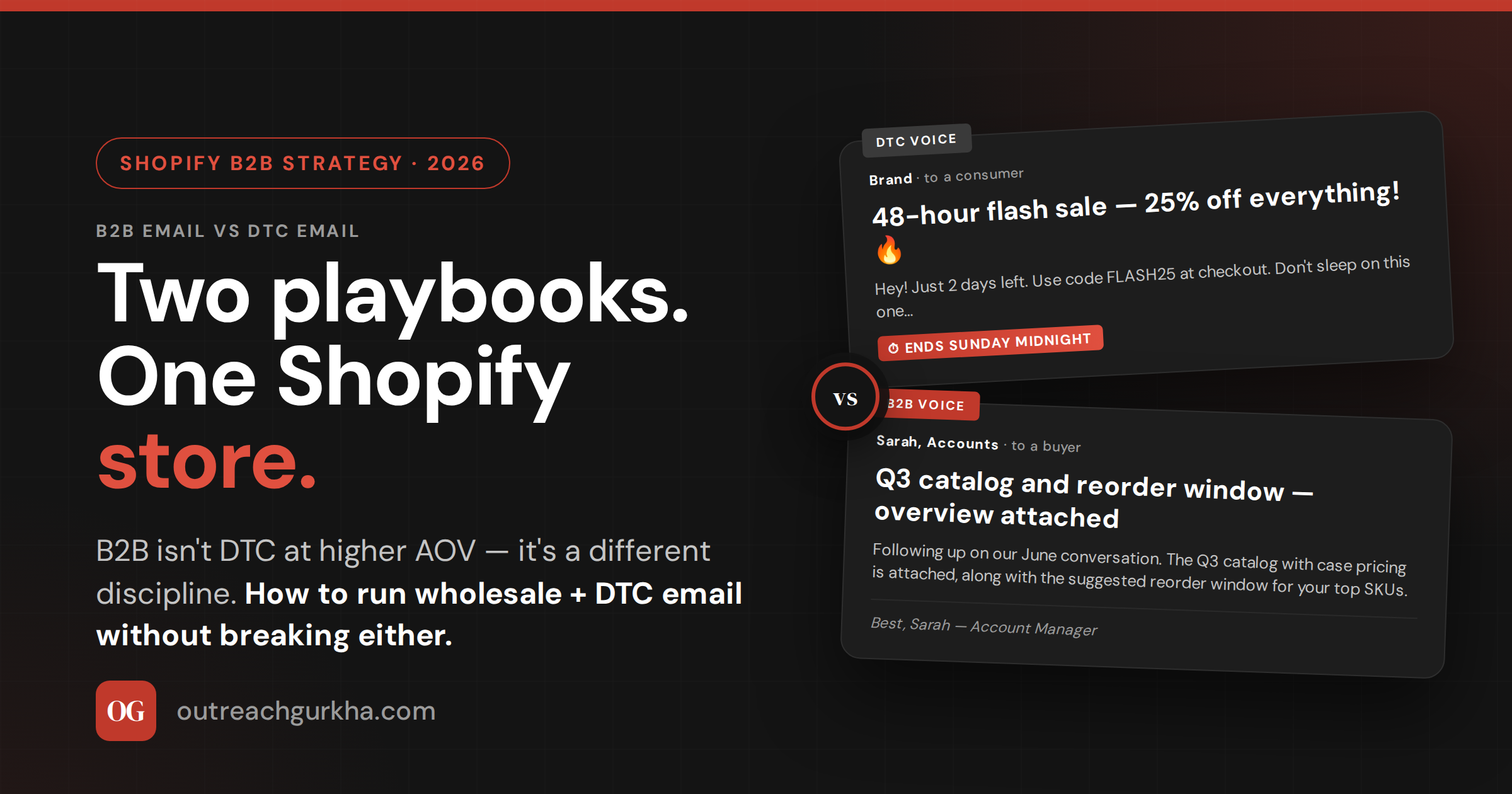
The voice difference is the part most agencies and in-house marketers underestimate. A DTC email and a B2B email asking for the same outcome (a purchase) should read like they came from completely different brands.
DTC voice — works for retail buyers
- “48-hour flash sale — 25% off everything!”
- “You left this behind 👀”
- “New drop. It’s gonna sell out.”
- Designed templates, brand colors, urgency
- Emoji where it fits the brand voice
B2B voice — works for business buyers
- “Q3 catalog and reorder window — overview attached”
- “Following up on the inquiry from June 4th”
- “New SKU available — case pricing inside”
- Plain-text, signed by a person, professional
- No emoji. No urgency unless it’s genuine.
The principle: DTC voice sells to a consumer making an impulse decision. B2B voice helps a professional buyer make a defensible business decision. Both are valid; they just shouldn’t be borrowed from each other. The Shopify brands that get this right write their B2B emails the way a good account manager would speak — direct, factual, helpful, signed by a real person.
7. B2B Email KPIs (They’re Different From DTC Benchmarks)
The biggest reporting mistake in B2B email: judging it against DTC benchmarks. Open rates run lower because business inboxes are noisier and Apple Mail Privacy hits B2B harder. Click rates are lower because B2B emails often drive an offline action (a call, a quote request) rather than a click. Conversion windows are weeks, not hours.
Here are the metrics that actually tell you whether the program is working.
| KPI | Why it matters | What to track |
|---|---|---|
| Reorder rate | The B2B equivalent of LTV. The single most important number. | % of first-order accounts placing a 2nd order within 90 days |
| Account expansion | Are reordering accounts spending more over time? | AOV growth quarter over quarter per account |
| Reply rate | B2B emails are conversational. Replies = engagement. | Replies / sends (track per sequence) |
| Deal velocity | Days from inquiry to first order. Faster = working. | Days between signup and first PO |
| Account churn | Accounts that ordered once, then went silent. | % of accounts with no order in 6 months |
Notice what’s not on this list: open rate, click rate, and revenue per send. Those aren’t useless — they’re just not the headline metrics. A B2B program with a 22% open rate and a 65% reorder rate is winning. A B2B program with a 40% open rate and a 15% reorder rate is failing the part of the job that actually matters.
Shopify B2B Email — Quick Reference 2026
Running both B2B and DTC on Shopify?
Let’s Build a Strategy That Works for Both
We’ll separate your B2B and DTC audiences cleanly, build the four-stage B2B lifecycle, set up the reorder reminder flow most wholesale programs are missing, and report on the metrics that actually matter — reorder rate, account expansion, deal velocity.
No retainer. No setup fee. We charge 10% of the email revenue we generate — after it lands in your Shopify account.
Free B2B + DTC audit, delivered as a Loom in 48 hours.
Klaviyo segmentation rebuilt to separate both audiences.
For Shopify stores running B2B + DTC together.