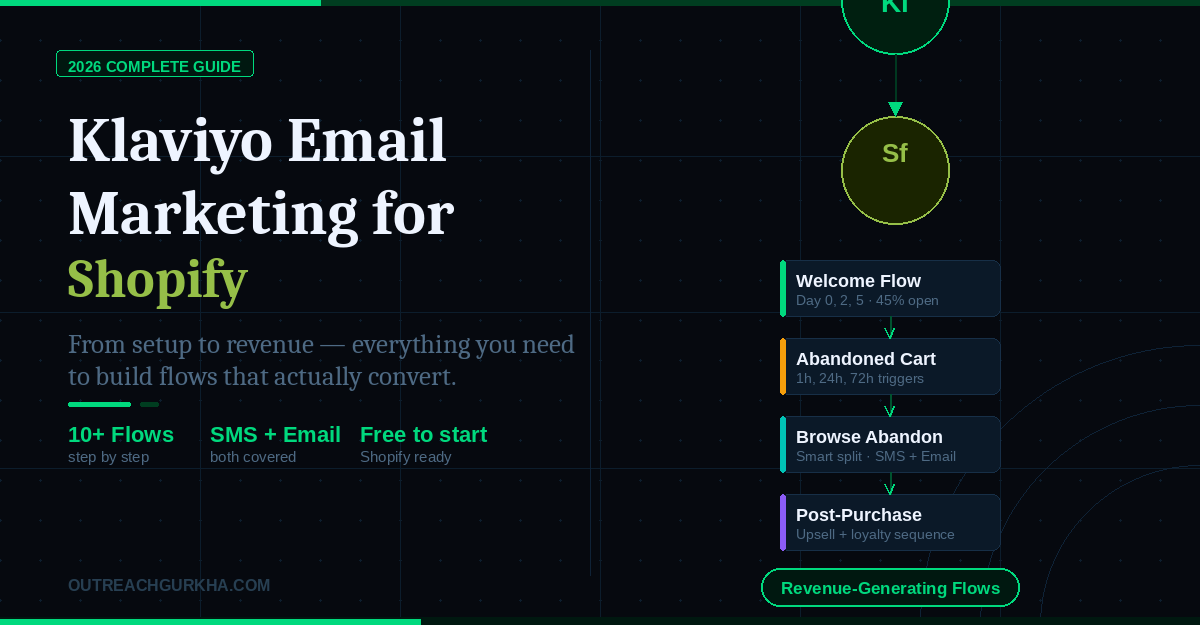
Complete 2026 Guide — Klaviyo + Shopify
Klaviyo Email Marketing for Shopify: The Complete 2026 Guide
Everything a Shopify store owner needs to know about Klaviyo in 2026 — from why it beats every alternative, to the exact flows, segments, and metrics that separate stores generating 8% email revenue from those generating 35%.
By Outreach Gurkha
Updated 2026
Read time 18 min
Level Beginner to Advanced
Email marketing generates between $36 and $72 for every $1 spent — the highest ROI of any digital marketing channel. But that number assumes you are using the right platform, set up correctly, with the right automation running.
For Shopify stores, the right platform is Klaviyo. Not because it is the most well-known, or the cheapest, or the simplest. But because it is the only email platform built specifically around the kind of behavioural data that Shopify generates — and the only one that converts that data into automated revenue at scale.
This guide covers everything: why Klaviyo, how to set it up correctly, the five flows every Shopify store must have, how to segment your list intelligently, which metrics actually matter, and the mistakes that are quietly destroying results for stores who think their email is working fine.
1. Why Klaviyo Is the #1 Choice for Shopify in 2026
Klaviyo is not just a popular email tool. It is the officially recommended email platform for Shopify Plus merchants, and Shopify holds an equity stake in the company. That relationship is not incidental — it means the two platforms are co-developed, with Shopify’s commerce data flowing into Klaviyo in under 200 milliseconds, in real time, across every customer action.
Here is what that means in practice — and why it matters for revenue.
The 2026 numbers that make the case
183,000+
brands using Klaviyo globally
18×
more revenue per recipient from flows vs. campaigns
41%
of total email revenue from just 5.3% of sends
$3.65
average RPR for abandoned cart flows
Source: Klaviyo 2026 Benchmark Report, based on 183,000+ customer accounts.
What Klaviyo does that Mailchimp, Omnisend, and Shopify Email cannot
| Feature |
Klaviyo |
Mailchimp |
Shopify Email |
| Real-time Shopify data sync |
✓ Sub-200ms |
Delayed sync |
Native but limited |
| Predictive lifetime value |
✓ AI-generated |
✗ |
✗ |
| Churn risk scoring |
✓ Per-profile |
✗ |
✗ |
| Conditional flow splits |
✓ Unlimited |
Limited |
✗ |
| Browse abandonment triggers |
✓ |
✗ |
✗ |
| Revenue attribution per email |
✓ Per-message |
Campaign-level |
Basic |
| Smart send time (per-person) |
✓ |
✓ (limited) |
✗ |
| 350+ native integrations |
✓ |
Fewer |
Shopify-only |
The core differentiator is the data layer. Klaviyo does not just know your customer’s email address — it knows what they viewed yesterday, what they bought six months ago, what their predicted next order date is, and how likely they are to churn in the next 30 days. That depth of intelligence is what makes Klaviyo automation generate 18× more revenue per send than a generic email blast.
2. Step-by-Step Shopify–Klaviyo Integration Setup
The integration takes under 30 minutes if you follow the correct sequence. Most setup problems come from skipping the authentication step or not enabling historical data sync. Do not skip either.
1
Create your Klaviyo account
Go to klaviyo.com and sign up. The free tier supports 250 contacts and 500 sends/month — enough to complete your full setup before upgrading. Immediately after signup: set your business name, physical mailing address (legally required in every email under CAN-SPAM), and your default “From” sender name. A personal sender name — “Aaditya from Outreach Gurkha” — consistently outperforms a generic brand name on open rates.
2
Connect via the Shopify App Store (not Klaviyo’s dashboard)
Go to your Shopify Admin → Apps → App Store, search for Klaviyo, and click Add App. This method automatically installs the Klaviyo.js tracking script across all your Shopify theme pages — which is what enables browse abandonment, product view tracking, and real-time event firing. If you connect from Klaviyo’s side instead, you may miss the tracking script and your browse abandonment flow will never trigger.
Critical setting — do not skip
When prompted, enable historical data sync. This imports your entire Shopify order history into Klaviyo immediately — activating predictive analytics (predicted LTV, churn risk score, next order date) using real data rather than waiting 90 days to accumulate it from scratch.
3
Set up domain authentication — SPF, DKIM, and DMARC
This is the step most store owners skip and the most expensive mistake in email marketing. Without authentication, Gmail, Yahoo, and Microsoft Outlook route your emails to spam silently — no error message, no dashboard alert. Since May 2025, Outlook rejects unauthenticated bulk mail entirely.
Go to Klaviyo → Settings → Email → Sending Infrastructure → Add a Sending Domain. Use a subdomain (e.g. send.yourbrand.com) — not your root domain. Klaviyo generates CNAME records you add to your DNS registrar. SPF and DKIM are handled automatically. For DMARC, add this TXT record manually to your DNS:
Verify it worked: send a test email to Gmail → open it → click the three-dot menu → “Show original” → confirm dkim=pass, spf=pass, dmarc=pass.
4
Verify the integration is live
Open your Shopify store in one browser tab (logged out) and Klaviyo’s Activity Feed in another. Browse a product page. Within 60 seconds, a “Viewed Product” event should appear in Klaviyo. If it does not, the tracking script is not installed correctly — go back to the Shopify integration settings and check that on-site tracking shows a green active status.
3. The 5 Must-Have Klaviyo Flows for Shopify
Flows are automated email sequences triggered by customer behaviour. They are the primary revenue engine of any Klaviyo account — generating 41% of total email revenue from just 5.3% of total sends. Build these five before you send a single campaign.
FLOW 1
Welcome Series
Trigger: Added to List
Open rate: 40–50%
RPR: $3.34 avg
New subscribers open welcome emails at 40–50% — more than double the rate of a regular campaign. This is your highest-attention window. A single “thanks for signing up, here’s 10% off” email wastes it entirely.
Deliver incentive + brand intro
“Welcome to [Brand] — your 10% off is inside. Here’s what makes us different from every other [category] brand you’ve tried…”
Bestsellers + social proof
“Here’s what 4,200 customers can’t stop ordering. [Product] has 847 five-star reviews — here’s why people keep coming back…”
UGC + community
“Real customers, real results. [Customer name] ordered [Product] in March. Here’s what she said three weeks later…”
Last chance on discount (non-purchasers only)
“Your 10% off expires at midnight tonight. After that, full price — no exceptions.”
Add flow filter: has not placed order since flow started.
FLOW 2
Abandoned Cart
Trigger: Checkout Started
Open rate: 50.5% avg
RPR: $3.65 avg / $28.89 top 10%
70% of shoppers abandon carts. Three-email abandoned cart sequences generate 6.5× more revenue than single-email sequences — $24.9M vs $3.8M across Klaviyo’s studied accounts. The structure matters as much as the timing.
Simple reminder — no discount
“You left something behind. Your [Product Name] is still waiting — we’re holding it for you. [Return to Cart →]”
Conditional split by purchase history
RETURNING BUYER
“847 people bought [Product] this month. Here’s what they said.” — Social proof, no discount.
FIRST-TIME VISITOR
“Still deciding? Here’s 10% off to help you make up your mind. Code: FIRST10. Expires in 24 hours.”
Final urgency — openers of Email 2 who didn’t buy only
“Last chance. We can’t hold your cart any longer. [Product] is selling fast — 14 units left. This is our final reminder.”
⚠ Critical: Add a flow filter — “has not placed order since flow trigger” — on every email. Without this, customers who complete their purchase continue receiving cart recovery emails.
FLOW 3
Post-Purchase
Trigger: Placed Order
Open rate: 40–45%
Repeat purchase rate: +10–15%
The customer who just bought is at peak brand trust. Most stores send a Shopify order confirmation and nothing else. Three emails over 14 days — onboarding, cross-sell, review request — is what separates stores with 18% repeat purchase rates from stores with 34%.
Structure: Email 1 (1–2 hours): Genuine thank you + product onboarding tips. Email 2 (Day 5): “Customers who bought [X] also love [Y]” — specific cross-sell, not generic. Email 3 (Day 12–14): Review request, sent after the customer has used the product. Sample subject: “How’s your [Product] treating you? Honest question.”
FLOW 4
Browse Abandonment
Trigger: Viewed Product (no cart add)
Open rate: 30–35%
RPR: $1.95 avg
Someone viewed a specific product and left. That is a purchase intent signal. One email sent 1–4 hours later, referencing the exact product they viewed, answering the likely objection behind the hesitation, and surfacing 2–3 reviews of that specific item.
Sample subject: “Still thinking about [Product Name]?” · Body: Show the product image, one short paragraph answering the most common objection (sizing/ingredients/compatibility), 2 customer reviews, one CTA.
FLOW 5
Win-Back
Trigger: 60–90 days since last order
Reactivation rate: 5–8%
RPR: $0.84 avg
A lapsed customer costs $0 to re-engage — they already know and trust your brand. The win-back sequence catches them before they churn permanently to a competitor.
Email 1: “We miss you — no discount, just checking in.” Reference their last purchase category. Email 2 (if no action): “Since you’ve been away — here’s 15% off, expires Friday.” Real deadline. Suppress immediately if they purchase at any point.
4. How to Segment Your Shopify Customer List in Klaviyo
Klaviyo’s benchmark research found that high-revenue stores average 133 active segments. Low-revenue stores average 13. Segmentation is not a nice-to-have — it is the primary technical driver of Revenue Per Recipient.
The reason is straightforward: a relevant email sent to the right person converts at 2–4× the rate of the same email sent to everyone. Start with these six segments and build from there.
✅ Engaged Subscribers (90-day)
Use for: all campaign sends
Opened email at least 1× in last 90 days OR Clicked email at least 1× in last 90 days
Send every campaign here — never to your full list. This one change improves RPR by 2–4× immediately by removing the unengaged contacts who drag down your sender reputation without contributing any revenue.
🏆 VIP / High-LTV Customers
Use for: early access, no-discount sends
Placed order at least 3× over all time OR Total spent is greater than [your AOV × 3]
These customers already trust you. They do not need discounts — they need exclusivity. Early product access, founder notes, and loyalty milestones convert this segment without margin sacrifice.
🆕 First-Time Buyers
Use for: second-purchase nurture
Placed order exactly 1× over all time AND Last order date is in the last 60 days
The hardest conversion is the second purchase. Target this segment with cross-sell campaigns and educational content that deepens product engagement — customers who buy twice are 5× more likely to become long-term loyalists.
⚠️ At-Risk Customers
Use for: win-back flow trigger
Placed order at least 1× AND Last order date is NOT in the last 60 days AND Last order date IS in the last 120 days
These customers are drifting. Catching them before the 120-day mark is significantly more effective than trying to re-engage at 180+ days. Feed this segment into your win-back flow immediately.
🚫 Non-Purchasers (Engaged)
Use for: first-purchase conversion
Placed order 0× over all time AND Opened email at least 1× in last 90 days
📉 Unengaged — Suppress
Exclude from all campaign sends
Has not opened email in last 180 days AND Has not clicked email in last 180 days
Sending to this segment damages your sender reputation with every send. Add it to the “Don’t send to” field on every campaign. A smaller, clean list always outperforms a large, unclean one.
5. Klaviyo Metrics Every Shopify Brand Must Track
Open rates are the most watched metric in email marketing and the least useful one. Since Apple’s Mail Privacy Protection update, open rates are significantly inflated — Apple pre-loads email pixels, registering opens that never happened. Here are the four numbers that actually predict revenue performance.
| Metric |
What it measures |
2026 benchmark |
Where to find it in Klaviyo |
| Revenue Per Recipient (RPR) |
Total attributed revenue ÷ total recipients. The single most diagnostic email metric. |
$0.08–$0.25 campaigns
$1.58–$3.65 flows |
Analytics → Flows / Campaigns → Revenue |
| Click Rate |
% of delivered emails with at least one click. More reliable than open rate post-MPP. |
2.5–4.5% campaigns
5–12% flows |
Analytics → Campaign detail view |
| Email as % of Store Revenue |
Total email revenue ÷ total Shopify revenue. The structural health metric. |
Target: 25–40%
Industry avg: 27% |
Analytics → Revenue → filter by Email channel |
| Flow vs. Campaign Revenue Split |
What percentage of email revenue comes from flows vs. campaigns. |
Target: 60%+ from flows |
Analytics → Revenue → breakdown by source |
| Unsubscribe Rate |
% who opted out from a send. Leading indicator of audience mismatch or over-sending. |
Below 0.25% |
Campaign / Flow analytics → Unsubscribes |
The metric most stores are missing: If your flow revenue is below 60% of total email revenue, you are over-reliant on active campaign work and under-invested in automation. According to Klaviyo’s 2026 data, flows generate 41% of total email revenue from just 5.3% of total sends. If your flows are generating less than 30% of your email revenue, the structure is broken — not the content.
6. Common Klaviyo Mistakes Shopify Stores Make — and How to Fix Them
1
Skipping domain authentication
Without SPF, DKIM, and DMARC, your emails route to spam silently. Klaviyo shows “Delivered” — the customer never sees it. Since May 2025, Outlook rejects unauthenticated bulk mail outright.
Fix: Settings → Email → Sending Infrastructure. Follow the CNAME setup. Add DMARC manually to your DNS. Verify in Gmail’s “Show Original” view — all three should show pass.
2
Sending campaigns to the full list
Your unengaged contacts have not opened in 180+ days. Every send to them trains Gmail and Outlook that your emails are low-engagement — which downgrades deliverability for your engaged subscribers too.
Fix: Send campaigns to your Engaged (90-day) segment. Add the Unengaged segment to the “Don’t send to” field. Your RPR will improve 2–4× on the next send without changing a single word of copy.
3
Offering a discount in abandoned cart email 1
You are training your customers to abandon carts on purpose. They learn: leave things in the cart for 45 minutes and get 10% off automatically. Every discount you give at email 1 is a discount you gave to someone who would have paid full price.
Fix: Email 1 = simple reminder, no discount. Email 2 = conditional split. Discount only for first-time visitors who have not purchased before.
4
Building only campaigns, not flows
Campaigns generate $0.08–$0.11 RPR. Abandoned cart flows generate $3.65 RPR. If 70%+ of your Klaviyo time goes into campaign creation and under 30% into flow building and optimisation, you are working on the wrong thing.
Fix: Build all five core flows before scheduling another campaign. Flows compound — they generate revenue every day without additional work. Campaigns stop the moment you stop sending.
5
Not using Smart Send Time
Klaviyo analyses each subscriber’s individual open history and knows the specific time window they are most likely to engage. This is free, built in, and most accounts have never enabled it.
Fix: When scheduling any campaign, toggle Smart Send Time on. Takes two seconds. Consistently improves open and click rates without changing any content.
6
Tracking open rate as the primary metric
Apple MPP inflates open rates for any subscriber using Apple Mail. A “42% open rate” in 2026 likely includes a significant volume of machine-triggered opens that never involved a human being. Optimising for open rates drives decisions that improve a distorted metric — not revenue.
Fix: Make Revenue Per Recipient your primary campaign metric. Track click rate as your engagement proxy. Open rate is useful directionally — treat it as a warning signal, not a success signal.
2026 Klaviyo Playbook — Quick Reference
1
Klaviyo is the only platform that syncs Shopify data in sub-200ms and converts it into behavioural triggers. In 2026, 183,000+ brands use it — flows generate 18× more RPR than campaigns, from just 5.3% of send volume.
2
Setup sequence: create account → connect via Shopify App Store (enables tracking) → enable historical data sync → set up dedicated sending domain → verify SPF/DKIM/DMARC all passing green.
3
Five flows = 80% of automated revenue: Welcome (4 emails), Abandoned Cart (3 emails, conditional split at email 2), Post-Purchase (3 emails over 14 days), Browse Abandonment (1–2 emails), Win-Back (2 emails at 60–90 days). Build in this order.
4
Build 6 core segments: Engaged (90-day), VIP, First-Time Buyers, At-Risk, Non-Purchasers, Unengaged. Send campaigns to Engaged only. Suppress Unengaged from every send.
5
Track RPR (not open rate) as your primary metric. Target: $0.08–$0.25 for campaigns, $1.58–$3.65 for flows. Email should contribute 25–40% of total store revenue. Flows should generate 60%+ of your email revenue.
Not getting results from Klaviyo?
Book a Free Klaviyo Audit with Outreach Gurkha
We audit Klaviyo accounts for Shopify stores doing $10K+/month and record a personalised Loom video showing every gap — broken authentication, missing flows, weak segmentation, and the exact monthly revenue your current setup is failing to capture.
The audit is free. It is specific to your account. Most founders who go through it see a number they were not expecting — not because the opportunity is hidden, but because nobody showed them how to read their own data against the benchmark before.
✓
No retainer. No setup fee.
✓
Delivered as a personalised Loom within 48 hours.
✓
We only charge 10% of the revenue we generate — after it lands.
Book Your Free Klaviyo Audit →
Read next
$
Email Marketing for Shopify — The Revenue Engine Most Stores Run at 20% Capacity
Flow benchmarks, segmentation impact, and the acquisition trap explained
📈
From Zero to $6,428 in 60 Days — The Exact Klaviyo Playbook We Used
Every flow, every campaign, every dollar — broken down for a real Shopify store
⚙
Inside the Machine — Our Complete 11-Stage Process for Building Email Revenue
Every stage, every decision, every cost-saving choice — nothing hidden
OG
Outreach Gurkha
Performance-only email growth engine for Shopify stores. We run your entire email channel — strategy, copy, design, automation, and reporting — and charge 10% of the revenue we generate. Based in Kathmandu. Focused entirely on your revenue.